Quick Answer
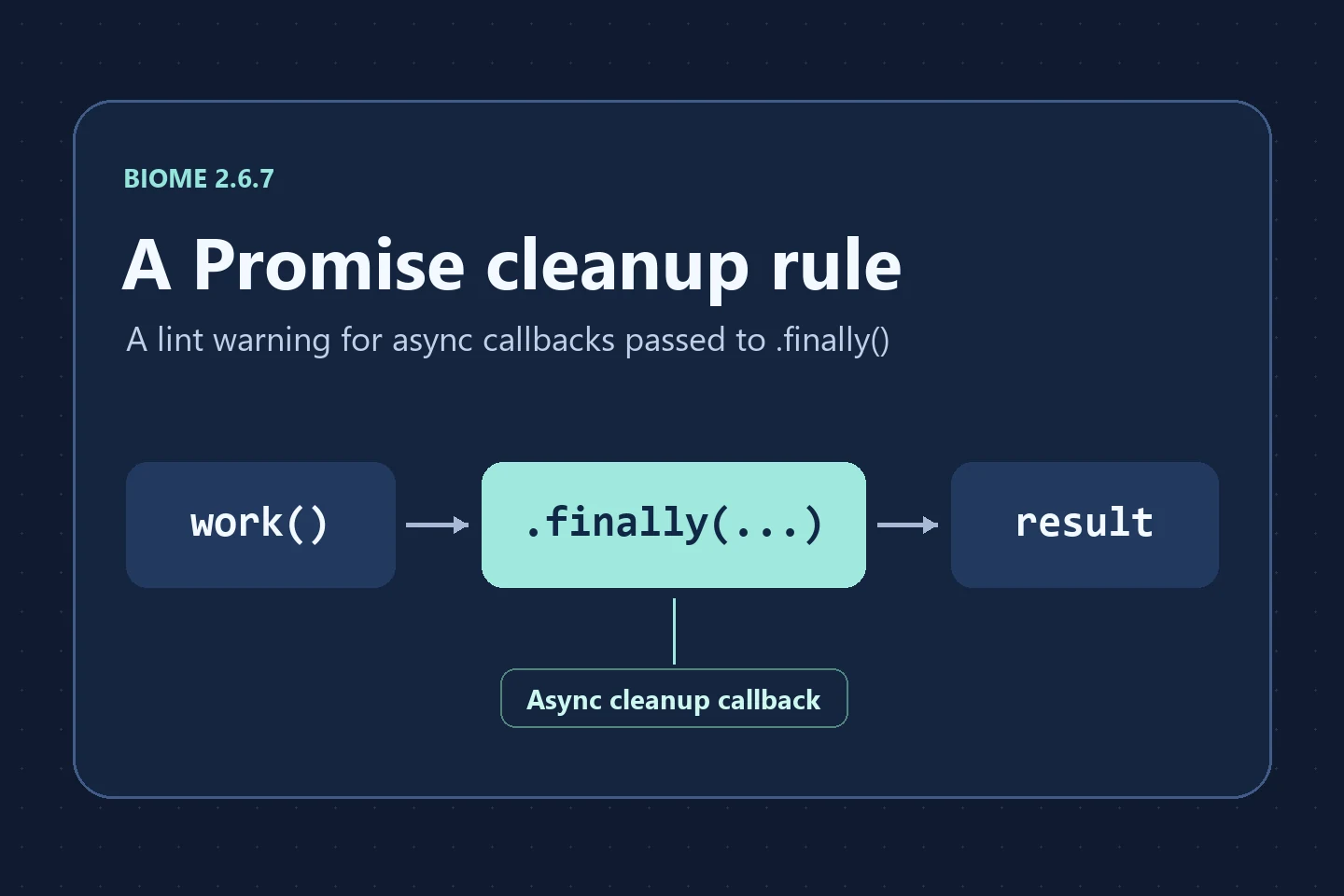
Biome CLI 2.6.7 adds noAsyncPromiseFinally, a nursery rule that reports supported async callbacks passed to a call named finally. Its practical concern is error replacement: cleanup that rejects can make the chained promise reject with the cleanup error, replacing the outcome that brought execution to cleanup.
The 2.6.7 release, dated November 11, 2026, includes the rule. As of this article’s November 20, 2026 KST evidence cutoff, the rule docs identify its default severity as warning and provide no automatic fix. Stable Biome versions require explicit opt-in for nursery rules.
Three evidential layers matter here. The merged code establishes a static pattern check. ECMAScript establishes settlement behavior for actual promises. The wider inference is that a warning can prompt developers to review cleanup policy; it does not prove that a particular cleanup operation will fail.
In Plain English
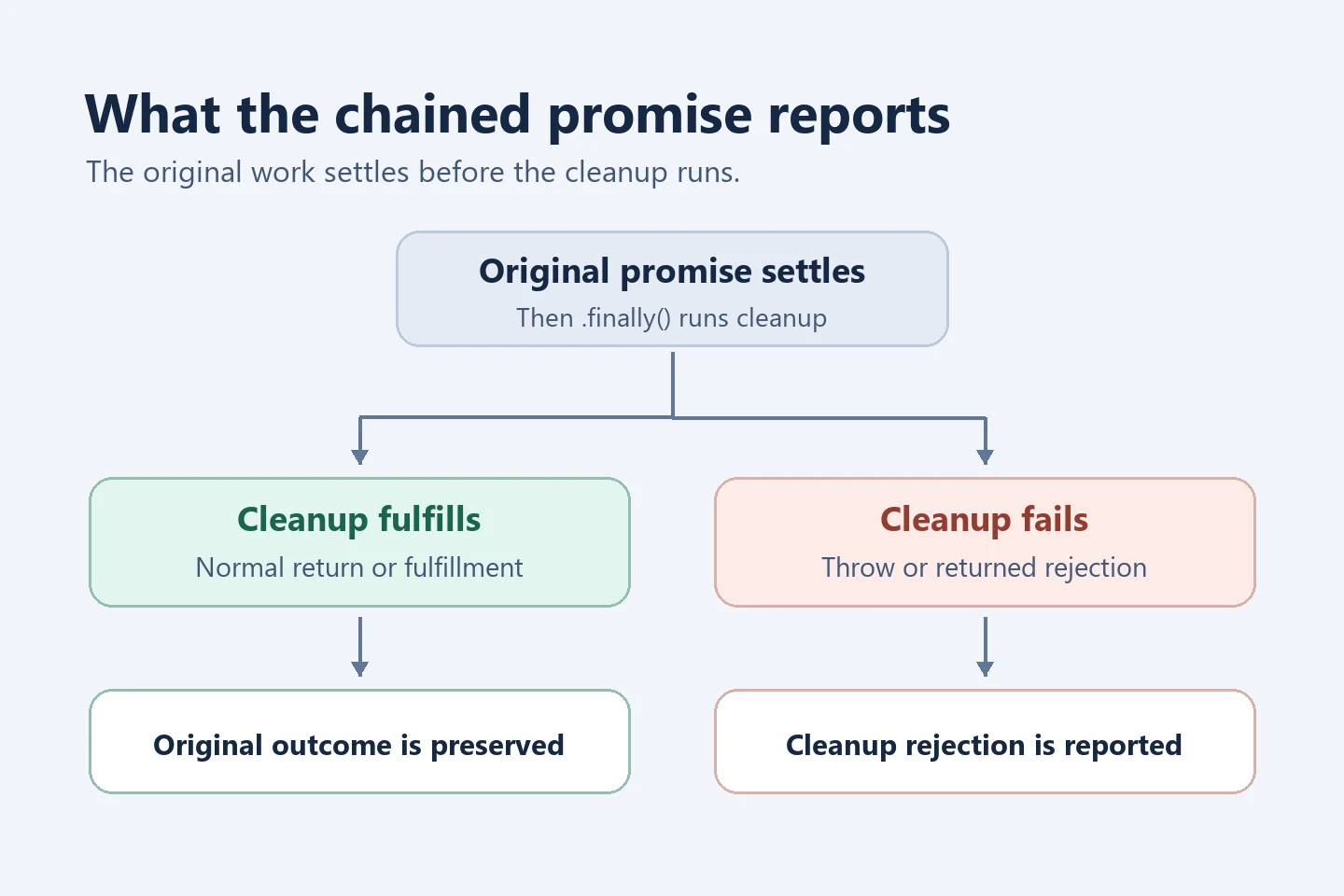
A promise’s finally() callback commonly releases resources or performs housekeeping after an operation settles. Successful cleanup preserves the original fulfillment value or rejection reason. But cleanup can itself fail, and that failure can become the rejection reason of the promise returned by finally().
That distinction matters when an application needs to retain the original failure. Suppose saving data rejects, then cleanup also rejects. A downstream rejection handler receives the cleanup error rather than the save error. Conversely, a successful save followed by rejected cleanup produces a rejected chained promise.
An async callback makes this possibility visible because it returns a promise. It does not guarantee rejection. A synchronous callback can also throw or return a rejected promise, producing the same replacement behavior. Biome’s new rule selects a recognizable syntax pattern within that broader language behavior.
Code Evidence
The merged commit, attributed to PR #12906, supplies the implementation evidence. The PR history records its merge on November 9. The earlier branch commit dates to November 3; it is distinct from the merged commit identified by the release notes.
The implementation examines a call, removes parentheses around its callee, and requires member access identifying finally. It examines the first argument when it is an expression and skips calls whose first argument is a spread. It removes supported type wrappers, and accepts a direct arrow or function expression or resolves a supported identifier through the semantic model. It reports async functions while excluding async generators.
This original illustrative example shows the direct callback shape:
const result = saveRecord().finally(async () => {
  await releaseLock();
});
If releaseLock() rejects, actual Promise settlement semantics make result reject with that cleanup error. The static warning does not establish that rejection will happen, or that replacing the original outcome contradicts the application’s intended policy.
The documented scope also includes supported async functions declared in the same file:
async function cleanup() {
  await releaseLock();
}

const result = saveRecord().finally(cleanup);
The docs additionally cover a local const binding initialized with an async function. Imported functions and functions accessed through an object are outside the documented check. For a separate same-file function declaration, the diagnostic can add the async token’s location alongside its callback highlight.
Name recognition covers dot access, bracket-string access, and a computed const string represented in the fixtures. Crucially, the inspected implementation does not require proof that the receiver has a Promise type. The code-based inference is therefore narrower than “Biome identifies every unsafe promise cleanup”: a matching call name and supported async argument can trigger the check without establishing runtime Promise identity.
To enable the experimental rule explicitly, the documented configuration uses:
{
  "linter": {
    "rules": {
      "nursery": {
        "noAsyncPromiseFinally": "error"
      }
    }
  }
}
This chooses error severity for the opted-in rule. It does not change JavaScript behavior or add a repair operation. The linter docs explain the stable-version opt-in requirement for nursery rules.
Why It Matters
The rule gives teams a review point where cleanup policy can otherwise remain implicit. Should cleanup failure fail the overall operation? Should it be recorded while preserving the original outcome? Either decision can be intentional, but it needs to match what downstream code expects.
A regular callback can handle an asynchronous cleanup rejection internally. This original illustration is appropriate only when swallowing that rejection is deliberate and the reporting handler fulfills:
const result = saveRecord().finally(() =>
  releaseLock().catch((error) => {
    recordCleanupFailure(error);
  }),
);
If reporting completes normally, the catch handler fulfills with its returned value, allowing the original promise outcome to pass through. If recordCleanupFailure() throws, cleanup still rejects. If reporting returns asynchronous work that must be observed, this example needs an explicit policy for that work too. Removing the async keyword alone does not settle those decisions.
This explains why the absence of an automatic fix matters. A mechanical rewrite cannot establish whether cleanup failure should be suppressed, propagated, or combined with another error. The wider inference is that the warning supports a policy discussion; the supplied evidence does not demonstrate fewer production failures, improved performance, or automatic migration.
An Open Question
When the main operation and cleanup both fail, which failure should your application expose to its caller, and where should it retain the other one?
Answering that question makes a lint finding actionable. Propagating cleanup failure may be correct for one resource boundary, while preserving the original failure may be more useful elsewhere. The rule identifies a place to inspect; application requirements determine the response.
Scope and Limitations
The ECMAScript specification supports the settlement explanation: successful cleanup preserves the original outcome, while thrown errors or rejected cleanup promises determine the chained rejection. That language guarantee applies to actual Promise behavior, separately from Biome’s static member-name recognition.
The documented exclusions, supported local bindings, first-argument check, and async-generator exclusion limit what this warning establishes. A clean lint result does not prove that cleanup cannot replace an outcome. A diagnostic also does not prove that the receiver is a Promise or that the callback will reject.
The snippets are original illustrations. No code or Biome tests were independently executed for this article, and no runtime or performance measurements are claimed. The evidence supports a new experimental check and its relationship to specified promise behavior.