
Quick Answer
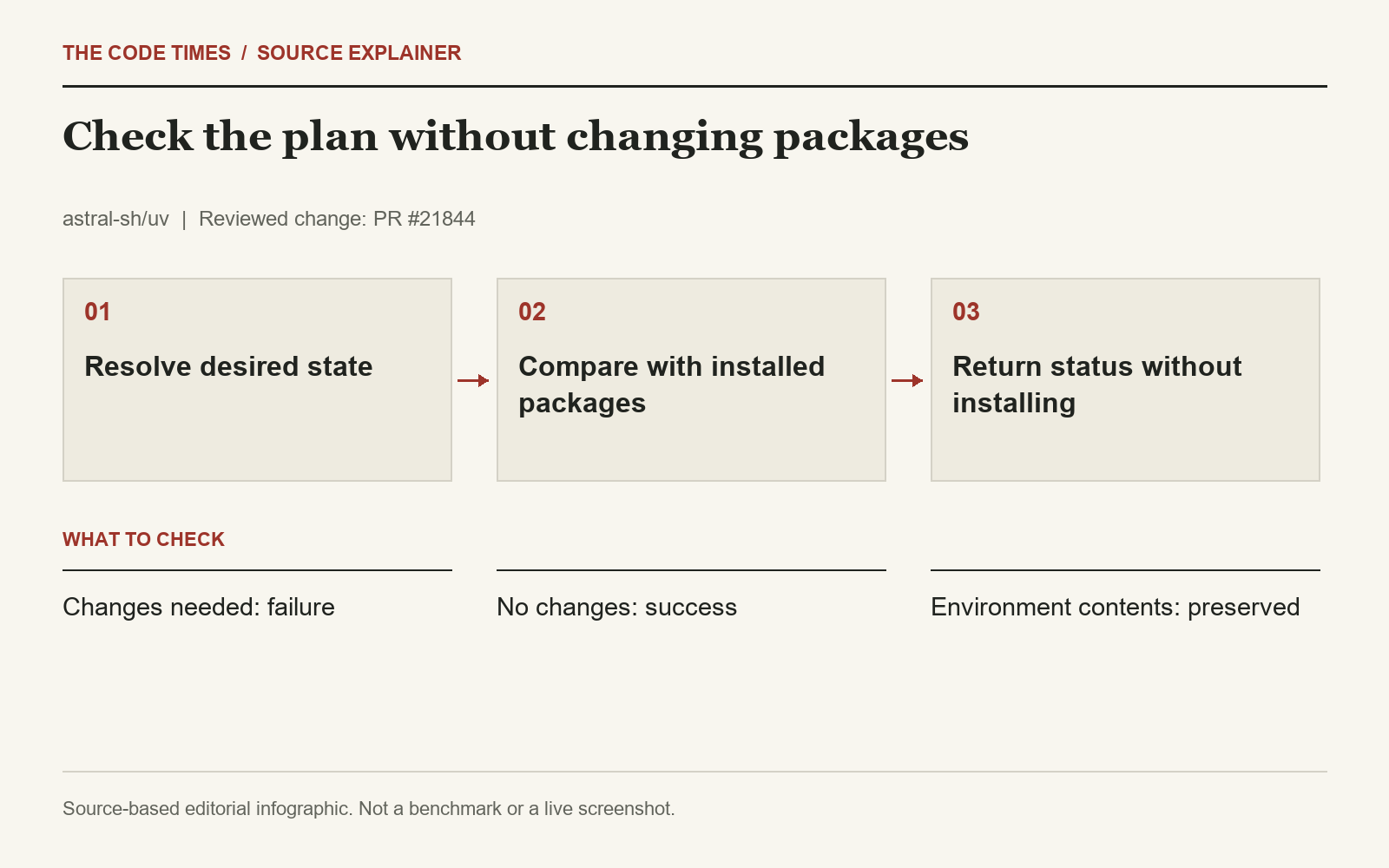
uv pip install and uv pip sync gain a check mode that reports required changes and returns a failing exit status when the environment does not meet the requested state.
In Plain English
A printed installation plan is useful to a person, but an automated job also needs a clear success or failure signal. Check mode combines those needs while leaving the installed environment unchanged. That makes it suitable for a validation step before a separate repair step.
Code Evidence
The CLI defines check as conflicting with dry-run. Settings map it to DryRun::Check, and the install and sync commands translate an outdated-environment result into failure. Tests cover an absent package, an already satisfied request, a version change, and a sync that would remove a package. The tests then verify the existing package remains available.
A Pipeline Scenario: Detect Drift Before Repair
Consider a team that reuses a Python environment across build jobs to avoid rebuilding it every time. The environment may satisfy yesterday’s dependency request while missing a package required by today’s branch. A verification stage needs to identify that mismatch and stop downstream work. Automatically installing the missing package would answer a different question: whether the environment can be repaired. Check mode gives the pipeline a way to preserve the evidence of drift while reporting a result that automation can act on.
The distinction matters when the job output becomes an audit trail. A successful repair can conceal that a supposedly prepared environment was incomplete at the start. A check that fails allows the team to route the problem to a separate provisioning step, rebuild the environment, or investigate a stale cache. Those are possible uses of the new status behavior, rather than workflows supplied by the patch itself. The source establishes the command result; the pipeline remains responsible for deciding what failure means.
Choose the State You Want to Enforce
The reviewed tests make install and sync worth considering separately. A request to install a dependency asks whether the requested requirement is satisfied. A sync operation also has a reason to remove packages that do not belong in the desired set. Therefore, a job intended to allow developer utilities alongside application dependencies may need a different policy from an image-build job intended to match an exact dependency set. Adding a check flag does not eliminate that policy choice.
The removal case is especially useful evidence because a read-only check must handle proposed deletions as well as additions. The test checks that the package remains available after the check reports that a sync would remove it. That connects the machine-readable failure to a meaningful preservation assertion. The command is not merely failing early before it has enough information to know the desired state; the reviewed behavior includes recognizing a change while leaving the current package contents in place.
How to Validate Adoption
A small disposable environment can exercise the relevant cases before a team changes its production pipeline. Start with a request that the environment already satisfies and inspect the process exit status. Then request an absent dependency or a different version and confirm that the job records failure. Capture the installed package inventory before and after each invocation so the result is checked independently of the explanatory terminal output. For a sync policy, include an extra package that the desired set does not contain.
Also inspect the wrapper around the command. A shell script that ignores exit codes, a job configured to allow failures, or a later successful command that masks an earlier failure can defeat the intended gate. That is an integration concern, not a defect shown in this patch. Keeping the verification result visible gives the team a clear place to decide whether to stop, report drift, or run an explicitly authorized repair. No benchmark or deployment execution is claimed here.
What This Check Does Not Establish
A matching package state is narrower than a healthy application. It does not prove that imports succeed under every configuration, that an external service is reachable, or that the application passes its tests. Dependency resolution can also involve reading configuration and obtaining information needed to determine the proposed changes. The source supports preservation of the installed environment in the covered cases; it does not justify describing the command as an offline or cost-free check. Teams should retain the runtime tests that answer their actual application questions.
Why It Matters
For a U.S. team managing many CI jobs, the practical value is a machine-readable boundary between verifying and modifying an environment. Our interpretation is that explicit failure lets a pipeline enforce its own policy. The check still has to resolve what would change; “no modification” should not be read as “no work or network access.”
An Open Question
Should a job use install or sync semantics? That depends on whether extra packages are acceptable. The removal case in the sync test is a reminder that satisfying requested dependencies and matching an exact environment are different goals.
Scope and Limitations
We reviewed source and regression cases rather than executing a CI pipeline. Check mode is listed in uv 0.12.18; consult the chosen command’s options for the intended environment policy.