
Quick Answer
FastAPI fixes frontend responses so dependency-generated headers and background tasks can reach the response sent to the client. The change aligns this path with behavior developers expect from ordinary routes.
In Plain English
A dependency can do more than return a value. It may set a cookie, add a response header, or schedule work after a response. Serving built frontend files through the same application should account for those effects when dependencies apply to that request.
Code Evidence
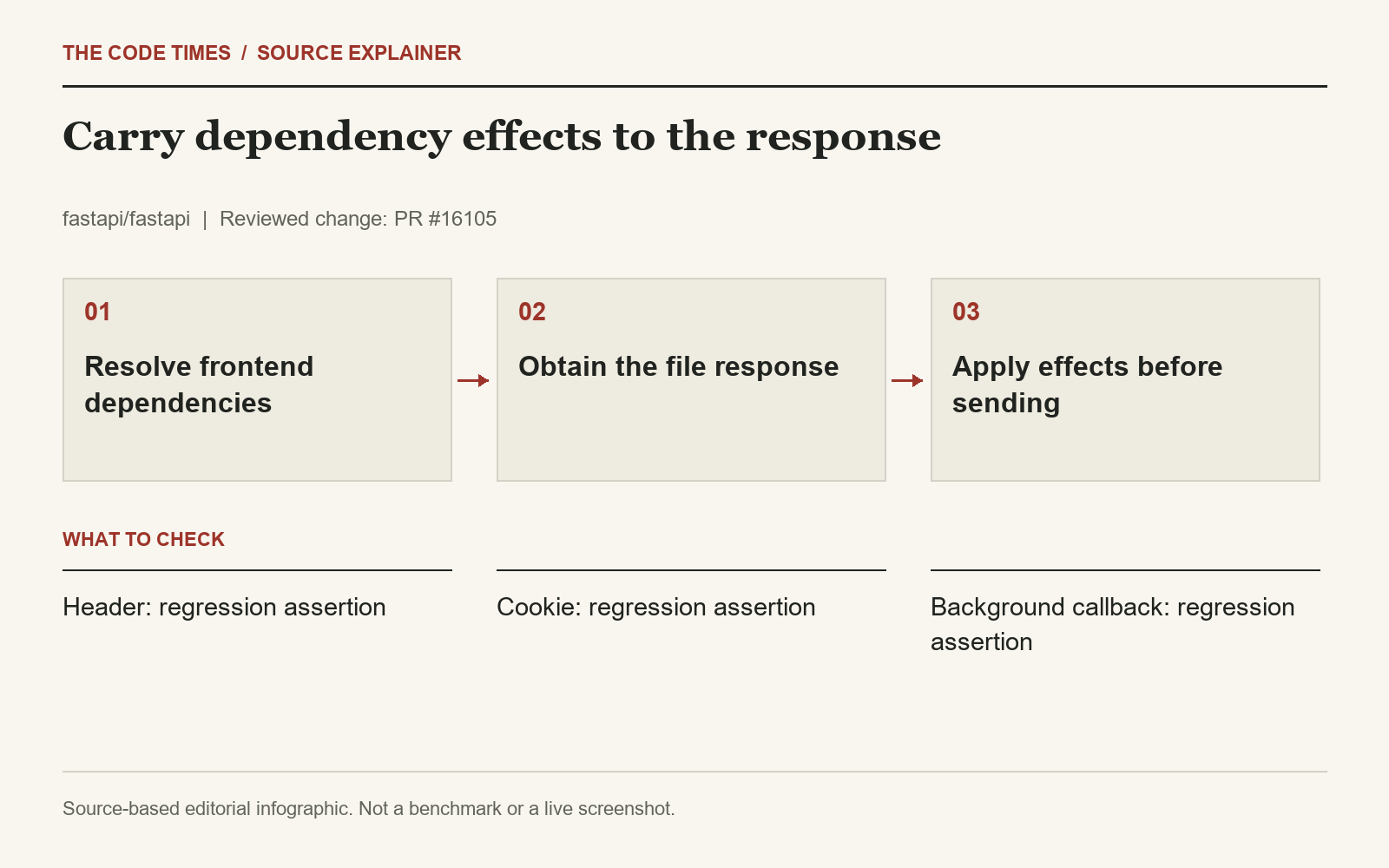
The routing code exposes a response-for-scope method and yields the solved dependency result. Before sending a frontend response, it attaches dependency background tasks when the response has no background task and extends the response’s raw headers. The regression test sets a header and cookie, schedules a callback, requests the frontend, and checks each result.
The Boundary Between Dependency Work and the Response
Dependency resolution and response delivery are separate stages of handling a request. A dependency may return a value for application logic while also accumulating response effects such as headers, cookies, or background callbacks. Those effects only matter to the client or application if the final response path carries them forward. A frontend file response can be assembled through a different route than a typical API result, which makes that handoff an important place to check.
The reviewed fix exposes the response for the request scope and makes the solved dependency result available at the point where the frontend response is prepared. The code then extends the response’s raw headers and conditionally attaches the dependency background tasks. This is a focused transfer of effects before sending the response. It does not require the frontend file itself to know that a dependency added a header or scheduled work.
A Concrete Application Scenario
Consider an application that serves its browser interface and API from the same FastAPI process. A dependency applied to the frontend request might add a request-tracking header, set a cookie used by the application, and schedule a lightweight callback. A developer can see that dependency run and still get surprising behavior if the final file response omits the accumulated effects. The patch addresses that final handoff, which is why checking only whether dependency code executed would be an incomplete regression test.
Headers and Tasks Have Different Rules
The reviewed implementation extends raw headers. That detail is relevant to teams that use multiple components to set response metadata, because extending a sequence is not the same operation as defining one universal precedence rule for every header name. An application’s actual response should be inspected when middleware, dependencies, and the frontend response all contribute related headers. The source summary does not establish how every duplicate or conflicting header should be interpreted by a browser or intermediary.
Background tasks have a separate condition: dependency tasks are attached when the frontend response has no background task of its own. That check prevents this article from describing the fix as an unconditional merge of all task collections. If a custom response already carries post-response work, the team should build a focused test for that combination. The simple regression case supports the dependency callback behavior it exercises, while the conditional assignment defines a boundary reviewers should preserve.
Validation Should Follow the Actual Request
To validate adoption, use a small frontend request with a dependency that supplies a recognizable header, a harmless test cookie, and a callback with an observable result. Assert the received response values and check the callback separately. Run the request through the same application path used to serve frontend files, rather than substituting an ordinary JSON endpoint. The reported defect concerns the frontend response path, so a passing API-route test would not answer the same question.
For an application with custom background work, add a second case in which the response already has its own task. Inspect which effects occur under the project’s intended arrangement and make that expectation explicit. If middleware or an external proxy modifies headers, inspect the response at the relevant boundary as well. These are suggested integration checks; no live server, browser session, or deployment was executed for this source review.
Where the Fix Stops
Carrying a cookie into a response does not establish the correctness of an authentication system. Cookie attributes, session validation, authorization, and caching policy remain application concerns. Similarly, a background callback attached to a response is not evidence of a durable queue with retries or recovery after a process failure. The concrete gain is that the frontend response can receive the dependency effects shown by the patch and regression test. Teams should evaluate broader reliability requirements through their existing application design.
Why It Matters
For teams hosting an API and a static frontend together, this patch makes response behavior less surprising. Our interpretation is that the key improvement is carrying dependency effects across the final response boundary. It does not establish that every authentication design is correct or that background tasks are durable jobs.
An Open Question
What if a response already has its own background task? The implementation checks that condition before assigning dependency tasks. Applications combining multiple sources of post-response work should verify the exact behavior they need rather than assume every task collection is merged.
Scope and Limitations
We reviewed routing changes and the added test, without running a FastAPI deployment. This is a focused fix in 0.141.1, not a new frontend build system.