Quick Answer
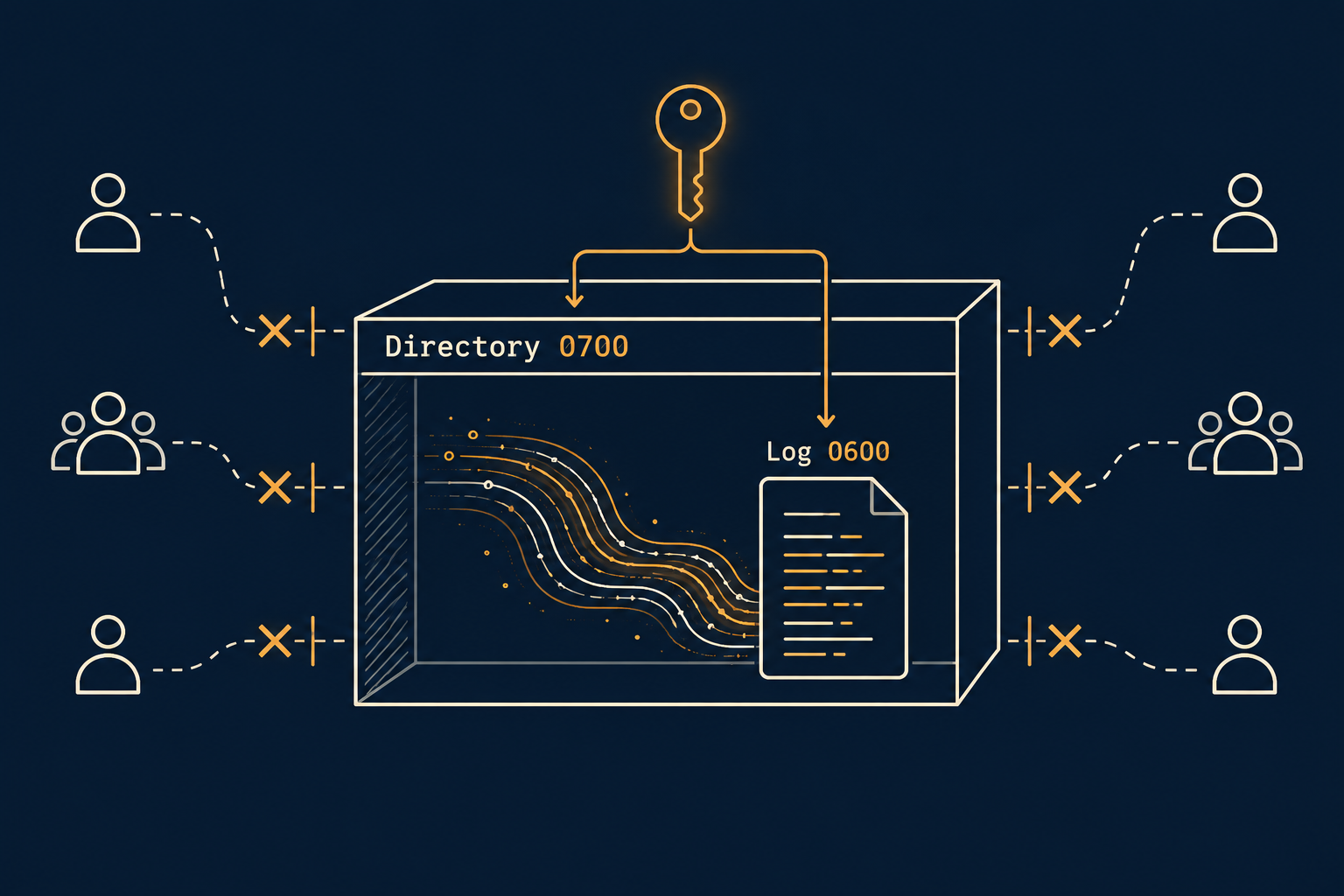
Aspire 13.6.4 explicitly limits Unix CLI diagnostic log files to owner read/write access, equivalent to mode 0600. It also creates or repairs Aspire’s dedicated logs directory with owner-only access, equivalent to 0700. The file restriction applies when the logger opens a reused log, before truncating or writing it. The official release notes include this change in the release published October 24, 2026.
There are two important boundaries. An existing custom parent directory keeps its permissions, and Windows file permission behavior is unchanged. The change also leaves diagnostic content intact: logs can still contain dashboard login URLs captured from AppHost output, according to the CLI privacy guidance.
In Plain English
Aspire’s CLI creates, runs, and manages Aspire applications. Its file logger captures diagnostic messages from Trace through Critical independently of the console verbosity setting. A quieter console therefore does not establish that the diagnostic file contains less sensitive information. These logger characteristics are recorded in the mainline patch.
The permission change addresses access to those files. Mode 0600 grants the file owner read and write permission, without granting permissions to the group or other users through that mode. For Aspire’s dedicated log directory, 0700 gives the owner the directory access permissions while granting none to the group or others through the mode. These are filesystem access settings; they do not remove sensitive values from a log.
The distinction matters when deciding whether to share a diagnostic file. The project specifically warns that dashboard login URLs can appear in captured AppHost output. Restricting local access does not replace reviewing the contents before sharing them. That review remains part of the documented guidance.
Code Evidence
Before: no explicit Unix file mode in the shown setup
The previous constructor created the parent directory with Directory.CreateDirectory and initialized a StreamWriter with append disabled. The code shown in the diff did not select an explicit Unix mode for the log file. This establishes what the implementation specified, rather than the effective permissions of every earlier installation.
After: creation and reuse receive explicit handling
The changed CreateWriter(string logFilePath) uses owner read/write permission when creating a Unix log file. For an existing log, it applies that mode through the opened file handle before truncating or writing. The release backport patch is the source for this ordering.
The following is editorial pseudocode summarizing the reported change. It is not a verbatim C# excerpt or a complete implementation.
// Editorial pseudocode: Unix log-file behavior
Before:
  create parent directory
  open writer with append disabled
  // No explicit Unix file mode in the shown setup.

After:
  create new log with owner read/write mode (0600)
  when opening an existing log:
    set mode to 0600 through the opened handle
    then truncate and write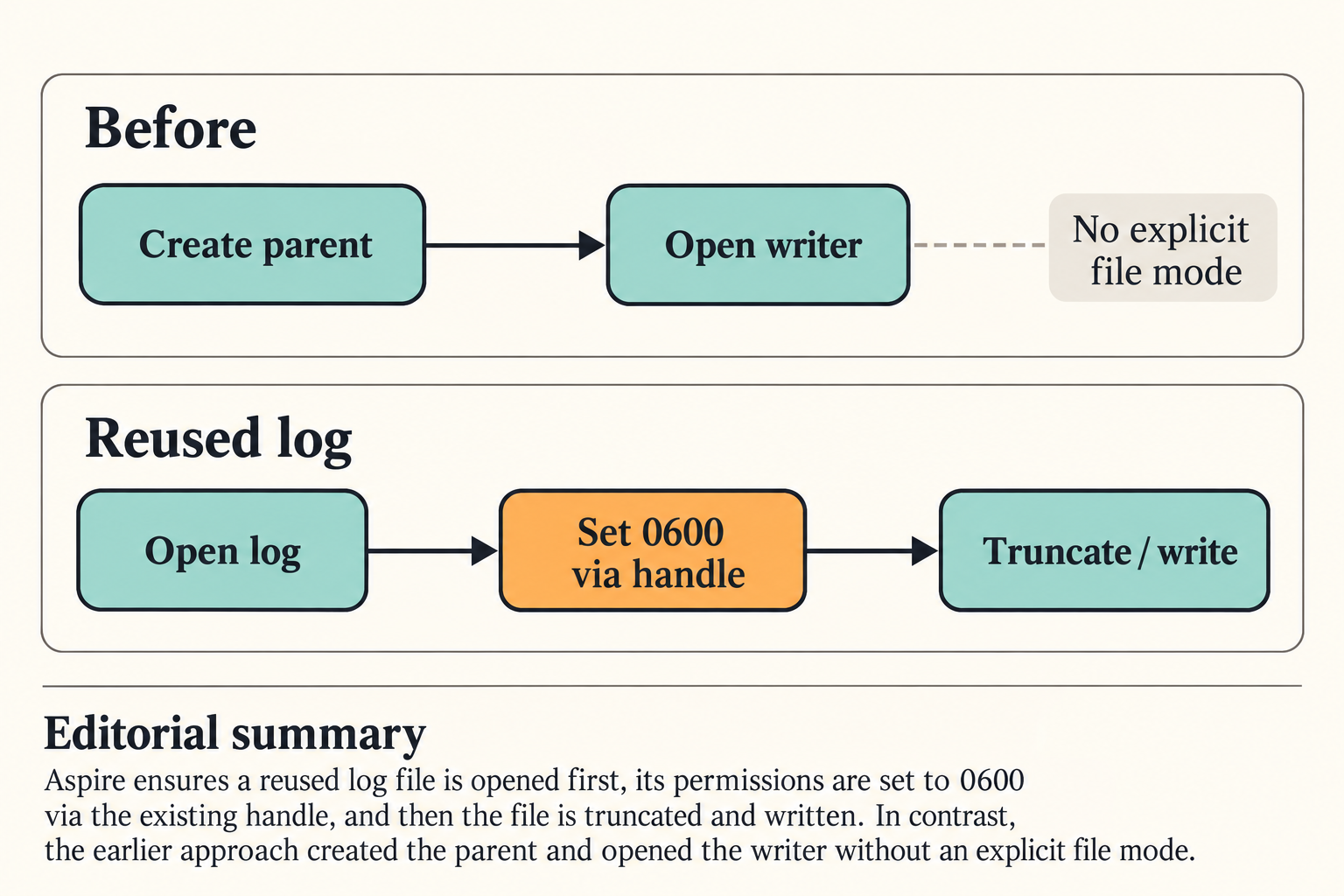
The reused-file path is a substantive part of the change. A creation setting alone would describe the permissions requested for a new file. The reported implementation also handles a file already present at the log path, applying the restriction before the new logging session truncates or writes it.
Directory handling has a deliberate boundary
The constructor distinguishes Aspire’s dedicated logs directory from a custom parent directory. For the dedicated directory, it uses a shared helper that creates or repairs owner-only access. A newly created custom log directory also receives mode 0700. An existing custom parent directory keeps its permissions. Both the patch and the README describe this boundary.
The changed constructor also handles setup failure explicitly. If it encounters an I/O or access error, it writes a warning and leaves the file writer and its channel unset. That observed branch is relevant when checking whether logging was successfully initialized; the permission change should not be read as evidence that a diagnostic file is always available.
Why It Matters
Our editorial interpretation is that this is local confidentiality hardening. The implementation narrows access through Unix file and directory modes, while the documentation continues to warn about sensitive log content. Those two facts explain both its value and its limit: the access policy becomes explicit, but the data still needs care when it leaves that location.
The earlier effective permissions remain a separate question. The old code’s lack of an explicit Unix file mode does not establish that all earlier logs were readable by other users. The supplied sources neither identify a specific incident nor demonstrate overly broad permissions on a particular earlier installation. The practical difference depends on the permissions that were previously effective there.
This is also a released change, rather than only a proposed mainline patch. PR #21276 merged into main on October 23, 2026. PR #21282 backported it to release/13.6 that day. The 13.6.4 release notes, published October 24, connect those changes and document the Unix modes. The release was listed as latest when checked on October 25; that does not establish which version any individual installation is running.
An Open Question
Should Aspire also offer optional redaction for sensitive URLs in diagnostic logs, given that filesystem permissions limit access but do not remove the URL from the log?
This is an editorial product question, not a claim that such an option exists or is planned. The reviewed material establishes permission handling and warns about URL content. Resolving the question would require a documented project decision about optional redaction and, if adopted, implementation and validation showing which sensitive values it covers.
Scope and Limitations
This article is based only on the supplied research covering the mainline patch, backport, release notes, and CLI README. No commands or independent tests were run for this article. The backport PR records a successful restore without warnings or errors and 23 focused logger and startup tests passing, with no failures or skips. That is the PR’s recorded validation, not an independent rerun.
The documented behavior does not change Windows file permissions or the permissions of an existing custom parent directory. The supplied evidence also does not establish effective access across ACL-enabled or network filesystems, or permission handling for copied and backed-up logs. It supports no claim of protection from root or processes using the same Unix account.
The reviewed sources make no CVE, vulnerability-disclosure, or exploit-fix designation. They establish an explicit Unix permission change and its release inclusion. They do not establish encryption, removal of login URLs, a confirmed breach, or a performance improvement.
For commit-level traceability, the report supplies the mainline change, release backport, and release commit. It does not supply an exact pre-change base commit. The before/after discussion therefore follows the supplied patch evidence without inventing a comparison base.
Sources
- Use shared helper for CLI log creation — PR #21276: mainline merge and shared-helper change.
- CLI log creation patch, mainline commit e1db371c6befd019d0639cd352e93ff59963eca0.
- Use shared helper for CLI log creation — release/13.6 PR #21282: backport and recorded validation. Backport f1b6624520ecc304788ed9c9ebb1c6379d581c48.
- Aspire 13.6.4 release notes: release inclusion, permission modes, and platform boundary. Release commit c89352703f78ae46de90fbf751ed8b52b77b89bf.
- Aspire CLI README: diagnostic log privacy: sensitive content and directory exceptions.