
Quick Answer
uv refactors project-edit recovery around snapshots of the files an operation may change. The guard is established before modifications and restores recorded content unless the operation commits successfully.
In Plain English
Adding a dependency can touch more than one file. If an operation fails after writing one of them, a project can be left between states. A recovery guard records the starting point and decides whether to keep or restore the edits when the operation ends.
Code Evidence
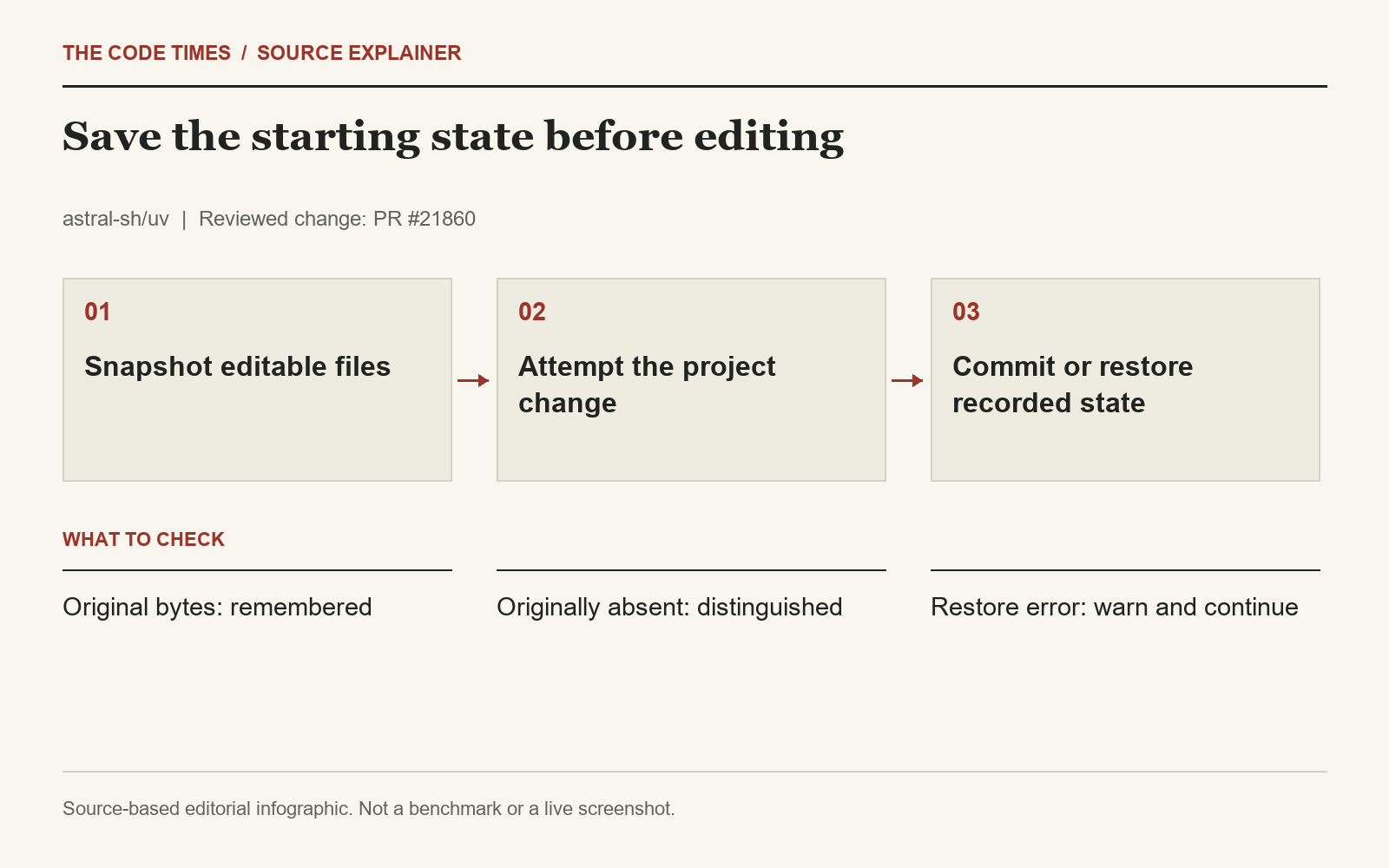
The new ProjectEdit collects unique paths and reads their bytes, including whether a file existed. Commit clears the snapshots; dropping an uncommitted guard attempts restoration. The revert loop continues after a restoration error and emits a warning. In the add path, frozen operations exclude a lockfile they cannot change, and a successful frozen edit explicitly commits.
The Failure Window This Design Addresses
Project editing is a sequence of operations rather than a single indivisible write. A dependency change can involve reading configuration, updating a project file, resolving requirements, and handling a lockfile. If an error arrives after one write but before the operation is complete, the files on disk can reflect only part of the intended change. Taking the recovery snapshot before modifications gives the operation an explicit starting state to return to when it does not complete successfully.
The reviewed design records bytes from the paths an operation may edit. That is useful because a recovery mechanism should restore what the user actually had, including details that may not be represented by a higher-level workspace model. The snapshot does not need to recreate the original text through a parser or reconstruct formatting from an object. Our interpretation is that this direct relationship between recorded content and restored content makes the recovery behavior easier to review.
Absent and Empty Are Different States
Suppose a project has no lockfile when an edit begins. A later stage creates one, and a subsequent stage fails. Writing an empty file during recovery would leave behind a new artifact that was not present originally. Remembering that the path was absent allows recovery to aim at the actual starting state. Conversely, a preexisting empty file is still a file whose existence was part of that state. These are small distinctions with practical consequences for later commands and version-control diffs.
Commit Separates Success from Recovery
On successful completion, committing clears the snapshots so dropping the guard does not restore the old content. Without that explicit success signal, the guard attempts restoration. The successful frozen edit therefore needs to commit too, even though its file-changing scope differs from a normal edit. This detail helps explain why recovery refactors must examine every successful return path as well as the failure paths. A guard that is never told about success could undo a valid change.
Restoration has its own failure modes. A file can become unwritable, a directory can be unavailable, or another filesystem condition can prevent recovery. The reviewed loop warns about a restoration error and continues trying the remaining files. Continuing is valuable because a failure for one path need not prevent recovery of every other path. It also means a warning is meaningful operational evidence: the user should inspect the resulting files instead of assuming that all snapshots were restored.
Validate With Disposable Project Copies
A useful adoption check starts with a small project copy whose original files and existence states are recorded. Exercise a successful dependency edit and verify that its intended changes remain. Then use a controlled failure case suitable for the team’s setup and compare the affected files with their recorded starting state. Include a case where a potentially created artifact was absent initially. Inspect both file contents and file existence, since comparing text alone would miss the distinction described above.
Frozen behavior deserves a separate case when a workflow relies on it. Confirm that a successful frozen edit persists and that files outside its editing scope remain outside the expected recovery work. These are proposed validation steps; this article does not claim to have run fault injection or interrupted a uv process. Tests that manipulate permissions or simulate filesystem failures should take place only in a disposable location where the expected aftermath is easy to inspect.
Keep the Guarantee Proportional
A drop-based recovery guard is not evidence of durable transaction logging across every process termination or machine failure. Nor does recording original bytes resolve the broader problem of two independent tools editing the same file at the same time. The patch gives normal project-edit control flow a clearer recovery mechanism. Version control and a review of the final diff remain useful ways to confirm the state a developer intends to keep, especially if recovery itself produces a warning.
Why It Matters
Our reading is that tracking actual file content makes the recovery boundary easier to understand than reconstructing it from a detached workspace object. The distinction between an absent file and an empty file also matters: recovery may need to remove a newly created artifact rather than write an empty replacement.
An Open Question
Is this equivalent to a durable database transaction? No such guarantee follows from the patch. Permission problems can still prevent restoration, and the code reports those failures. Teams should continue to use version control for project changes.
Scope and Limitations
This article covers the reviewed snapshot implementation and add path. We did not interrupt a live uv process or test filesystem failures. The release notes include the recovery work in 0.12.18.