
Quick Answer
Vite now prepares proxy URL matchers when the development server is created. Regular expressions no longer need to be constructed again for each matching attempt.
In Plain English
A development proxy forwards selected requests to another service. A context can be a simple path prefix or a regular-expression pattern. The pattern usually stays the same while many requests pass through the server, so its preparation can be separated from request handling.
Code Evidence
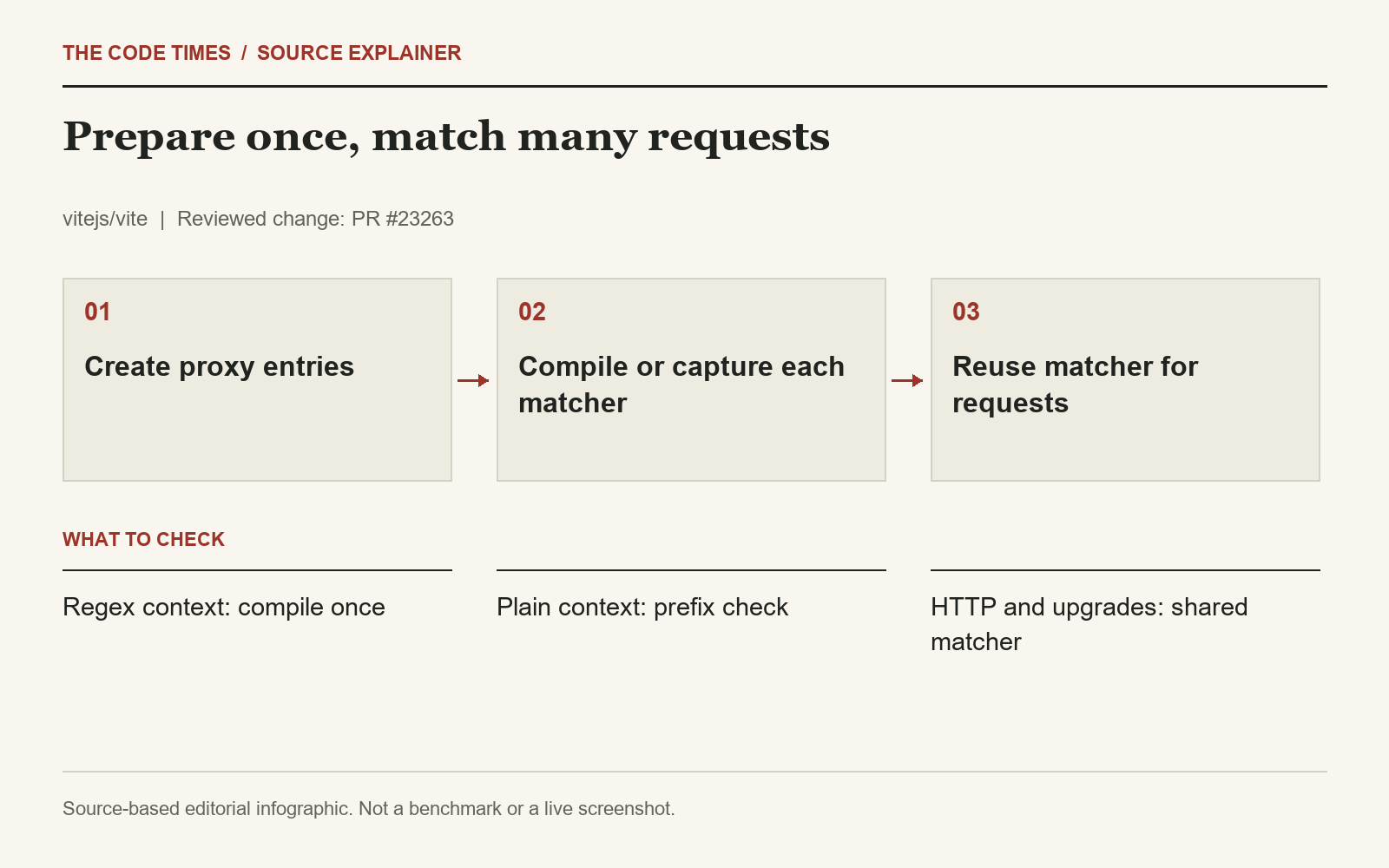
The proxy middleware introduces createProxyContextMatcher. A context beginning with a caret is compiled once and captured by a matching function; other contexts use startsWith. Each proxy entry stores that function alongside its options. Both HTTP request handling and WebSocket upgrade handling call the stored matcher.
Why It Matters
Our reading is that this removes repeated setup work from a frequently used path. The benefit will depend on the number of rules and requests, and the diff supplies no universal speedup figure. It also makes the distinction between pattern rules and plain prefixes explicit in one place.
Separate Preparation from Matching
A proxy rule has two phases that are easy to blend together in code. First, the server interprets the configured context and prepares a way to test it. Later, each request supplies a URL to that test. When the context is unchanged, repeatedly preparing it does not add new information. The revised structure makes that distinction visible by storing a matcher with the proxy entry.
The caret remains the switch between the two supported interpretations described by this patch. A context that begins with that character is treated as a regular expression; an ordinary context follows the prefix path through startsWith. That means developers should continue to read their configuration according to the existing syntax. The refactor is not evidence that every context string has become a regular expression or that plain prefixes now require regex escaping.
A Practical Development Scenario
Imagine a frontend team whose development server forwards API requests to a local backend while also forwarding a WebSocket connection for live updates. A page can make many API calls during one editing session, while the configured contexts remain unchanged. The new arrangement prepares each context when the proxy entries are created, then reuses the stored function as those requests arrive.
The shared use in HTTP and upgrade handling matters for review. An optimization applied to only one branch would leave two places to understand and potentially two ways for matching behavior to diverge. Here, both branches call the matcher associated with the entry. This is a source-level observation about organization and reuse; it does not establish that all HTTP and WebSocket configuration options are interchangeable.
Check Routing Before Measuring Speed
A useful validation begins with the behavior users actually depend on: which requests reach which service. Choose one plain prefix rule and, if the project uses it, one caret-prefixed pattern rule. Include a URL that should match and a nearby URL that should not. Keep the expected backend destination explicit so that a successful HTTP response from the wrong service cannot masquerade as a passing check.
For a project using WebSockets, verify a real upgrade against the applicable rule as a separate observation. Loading a page successfully does not prove the upgrade branch worked. Also include any configured rewrite or bypass behavior relevant to the application, because the matcher only decides whether a context applies; the rest of the proxy pipeline still determines what happens next. These are suggested project checks, not claims that we executed them.
Only after routing remains correct does a performance comparison become meaningful. Hold the rules and request mix constant, record the process version, and distinguish time spent in the local proxy from time waiting on its destination. A slow backend can obscure a reduction in local setup work. Conversely, a synthetic run that avoids backend work may exaggerate how noticeable the change will be to a developer using a real application.
Read the Claim at the Right Scale
The code supports a specific statement: construction of the regular-expression matcher moves to proxy setup, and request paths reuse it. It supports no particular percentage improvement. The number of contexts, the number of matching attempts, and the amount of unrelated work all affect whether the saved preparation is material in a given session.
This also explains why a development-server improvement should not be described as a production networking upgrade. A deployed site may use a completely different server or edge proxy. Teams can welcome the cleaner division of work while keeping their release assessment tied to the process that actually runs Vite. The patch is a focused optimization with a reviewable mechanism, and its observable payoff remains a workload question.
An Open Question
How much does pattern preparation contribute to latency in a real project? A team would need a representative workload to answer. Network calls to a backend could dominate, making this change difficult to see in an end-to-end measurement.
Scope and Limitations
This article reviews source structure, not a performance benchmark. The patch changes matcher construction and use; it is not evidence that the application’s production proxy behaves differently.